Why You Feel Lost When Life Slows Down
There are moments when life slows down just enough for something to break through.
A long weekend. A holiday. A calm evening when the day's demands finally fall away. And suddenly — in the stillness — questions you've been too busy to ask start surfacing.
Why do I feel lost when nothing has actually changed? Am I having some kind of identity crisis? Have I outgrown this chapter of my life?
It's always framed as a problem. As if feeling disoriented is a sign that something has gone wrong.
But I've come to think the opposite is true. Feeling lost when life slows down may be the clearest sign that you are actually getting closer to yourself than you've been in a long time.
When the noise stops, something surfaces
We spend most of our lives in motion.
Working, managing, delivering, adapting. Meeting the demands of our roles — at work, at home, in every relationship that needs something from us. We get good at it. Exceptionally good, some of us. And in that motion, we develop a kind of internal management system: notice the uncomfortable feeling, reframe it, get busy, keep going.
It works. Until it doesn't.
When life slows — a holiday, a Sunday with nowhere to be, a long drive alone — that management system loses its fuel. The motion stops. And in the quiet, what surfaces is everything you've been moving too fast to hear.
That's not a crisis. That's information.
The darkness that makes things visible
Living in Copenhagen has taught me something about stillness I hadn't fully understood before.
Here, when the days contract and the light disappears before the afternoon is over, something shifts. Not just in the weather — in people. The pace changes. The social obligations thin out. And in that shift, something ancient stirs.
I went to an event once about what actually happens to us when things slow down and get dark. Not metaphorically, but physiologically, historically. And I was struck by how deeply wired we are for this rhythm — the one that quieter seasons demand of us.
Long before constant connectivity, darkness was a biological instruction. It told us to pause, to rest, to think, to let the year settle into our bones in a way that allowed us to understand ourselves again. It made introspection inevitable. It made being with ourselves unavoidable.
We've overridden that mechanism now — with screens, with schedules, with the relentless pace of a world that doesn't stop. And I'm not against any of it. But I do think we've lost something important in the process: the built-in moment where our interior life gets a chance to catch up with our exterior one.
When you keep going at the same pace, ignoring the cues your body and psyche are sending, of course the quiet moments feel like confusion. Of course stillness feels like something is wrong.
It's not wrong. It's just the truth, finally loud enough to hear.
The drift you didn't notice
What makes these moments feel so disorienting isn't that you're lost. It's that the pace finally slows enough to notice the truth you've been too busy to feel.
All year — all decade, perhaps — you've been adjusting yourself. Suppressing impulses. Following expectations. Performing competence. Meeting the version of you that everyone around you needs.
Sometimes beautifully. Sometimes just barely.
And somewhere in all of that, the version of you that is performing and the version of you that is real start to drift apart. Slowly, quietly, without any single dramatic moment you could point to.
That drift doesn't announce itself. It shows up in small ways: the unexplained restlessness, the low-grade dissatisfaction, the decisions made from habit rather than desire. The feeling of being slightly misaligned with your own life — and not knowing when that started.
When things get quiet, that drift becomes impossible to ignore.
It feels like an identity crisis only because it may be the first time in months you've actually stopped to hear yourself think.
What women say when the roles fall away
The conversations I've had with women in this moment follow a pattern I've come to recognise.
They are leaders, creatives, professionals. They look, from the outside, like they have it together. And then, somewhere in the conversation, something quieter surfaces:
"I don't feel like myself anymore — but I also don't know who I'm supposed to be." "I feel like I'm in-between chapters." "I'm not burned out, but I'm not fully here either." "I've been performing a version of myself that isn't quite me."
None of these women are falling apart. They are waking up.
They are noticing the distance between the identity that brought them approval, belonging, and predictability — and the identity that feels true, alive, and much riskier to inhabit.
This is not about becoming a new person. It's about the particular pain of outgrowing a version of yourself that once worked. Sometimes beautifully. But no longer reflects who you actually are.
And there is no applause for that moment. No external validation. No map handed to you.
It is simply the part of the story where you walk in the dark for a while — learning, slowly, to trust your own sight.
Always chasing another wave
When I lived in the US, I met people who described their relationship to life like this: "There's always another wave to catch."
Another opportunity. Another project. Another moment of reinvention. The endless possibility, the momentum, the light.
And in some ways it's intoxicating. But I've come to believe we are not built for perpetual motion. We need the in-between. The spaces where nothing is happening outwardly but everything is shifting internally.
Without that, we stay in motion but lose direction. We become successful but disconnected. We keep performing an identity that once made sense — and miss the moment to ask whether it still does.
That is why the quiet moments hit so hard. They are the one time the waves stop long enough for the truth to surface: I cannot keep being who I've been.
You're not disappearing. You're reappearing.
So if you feel lost right now — a little foggy, stretched thin, strangely unsettled — I want to say this clearly:
You are not disappearing. You are reappearing.
This is not you becoming someone new. This is you no longer being able to hide the person you actually are.
The feeling of lostness that arrives in the quiet is not a warning. It is a threshold. The beginning of something more honest, more grounded, more internally true than the version of yourself you've been performing.
There is no clarity yet. No map. No guaranteed outcome.
But the feeling itself — the hum, the low signal, the question that won't leave you alone — that is not a problem.
It is the most honest thing about you right now.
And it is worth listening to.
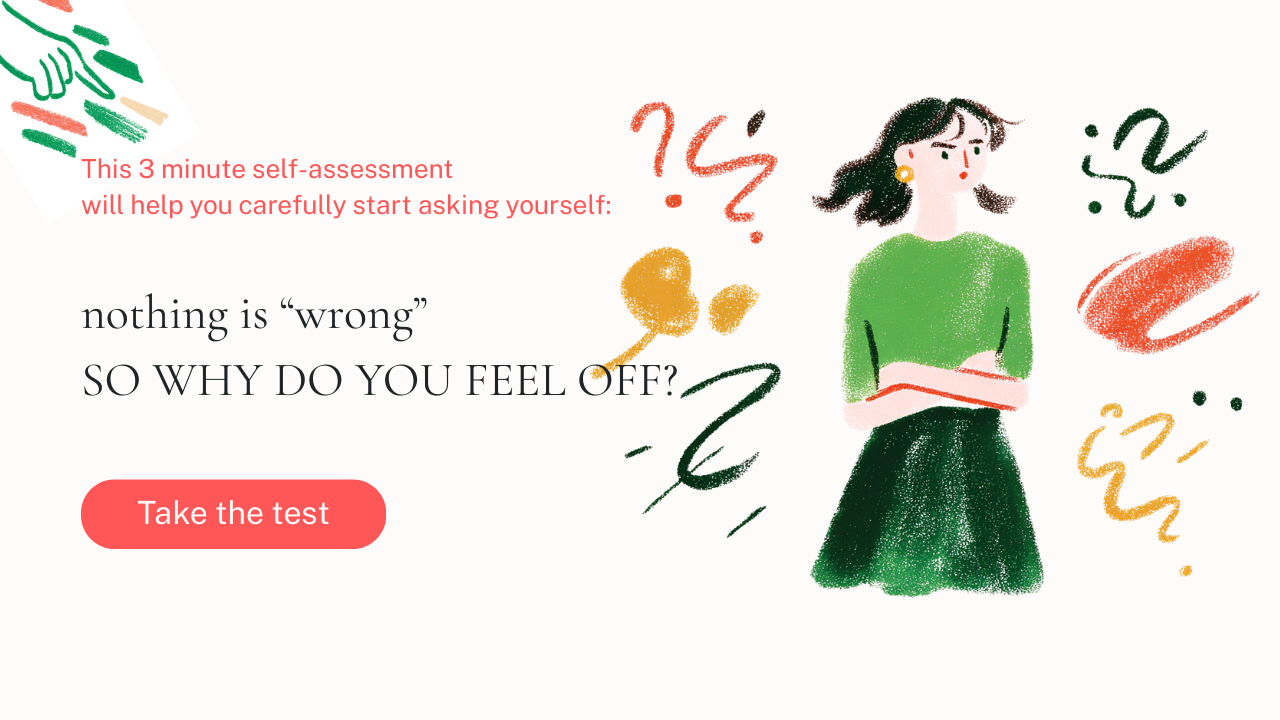
If you want to understand what that feeling might be telling you, the short self-assessment is a good place to start. And if you're ready for something more structured, the Inner Authority Method was built for exactly this moment.