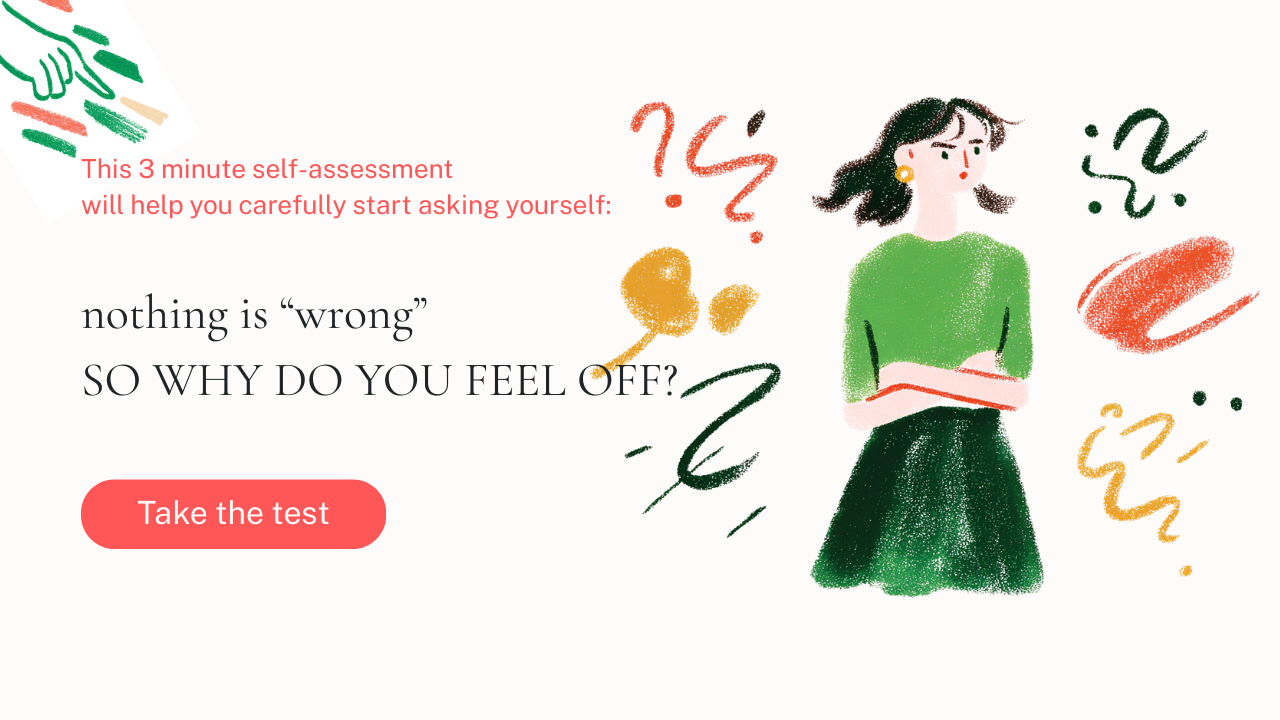
You Are Not Becoming Someone New. You Are Becoming More Yourself.
There is a story we tell about change.
It goes like this: at some point in your life — usually somewhere in the middle — you wake up and realise that something needs to be different. And so you reinvent yourself. You find your passion. You become a new version of who you were. Bolder. More authentic. More alive.
It is a compelling story. It is also, I think, the wrong one.
Because the women I have spoken to — the ones sitting with that quiet, persistent feeling that something is off — are not looking to become someone new. They are exhausted by the idea. They have spent years becoming things. Becoming the professional, the mother, the reliable one, the capable one, the one who holds it all together.
The last thing they need is another becoming.
What they actually want — what the feeling is actually asking for — is something closer to a return.
Who you were before the world had opinions
Before the world told you who to be — you already were someone.
Not fully formed. Not finished. But essentially, fundamentally, recognisably yourself. You had things that lit you up and things that didn't. You had instincts about people and situations that turned out to be right more often than you gave them credit for. You had a way of moving through the world that was yours — before you learned to adjust it, moderate it, make it more acceptable, more professional, more appropriate for the room.
That person did not disappear when life got serious.
She went quiet. She learned to wait. She got very good at watching from the inside while the performed version of you handled things on the outside.
But she never left.
And now — in the restlessness, in the wrongness, in the feeling that the life you have built fits on paper but not in your body — she is asking to come back.
Not loudly. Not with demands. Just persistently. The way something true always persists.
The first half of life
There is a reason this feeling tends to arrive in the middle.
The first half of life is, more or less, about learning to belong. To figure out the rules — of your family, your culture, your profession, your gender — and to become someone who can operate within them. Someone who is taken seriously. Someone who is loved, valued, rewarded.
This is not cynical. It is just what the first half of life asks of us. And most of us do it well. We are good students. We learn what is expected and we deliver it — sometimes with genuine enthusiasm, sometimes through gritted teeth, often some complicated mixture of both.
The result is a life that works. A self that functions. A version of us that the world recognises and approves of.
And underneath it — quiet, patient, still present — the version of us that was there before any of that started.
What the second half is actually for
The second half of life asks something different.
Not more building. Not more becoming. Something harder and stranger and ultimately more freeing than either of those things.
Shedding.
The slow, sometimes uncomfortable process of letting go of what was never really yours. The expectations you absorbed so completely that you stopped being able to distinguish them from your own desires. The roles you played so well that you forgot they were roles. The version of success you pursued because it was the available version — not because it was true.
This is not a crisis. It is a developmental stage. One that every person who lives long enough eventually reaches — though not everyone recognises it for what it is.
What it feels like, from the inside, is wrongness. Misalignment. The low, persistent sense that the life you are living and the person you actually are have drifted apart — gradually, quietly, over a long time.
What it actually is: the beginning of the return.
We do not change at our core
Here is the idea at the heart of all of this. The one that changes how you look at everything else.
We do not change at our core.
We grow. We learn. We accumulate experience and wisdom and hard-won perspective. But underneath all of that accumulation — there is something that stays. Something that has always been there. A set of instincts, values, ways of seeing and being in the world that are essentially, recognisably, continuously you.
You have been testing those instincts your whole life. Every experience has informed them. Every choice — good or bad, yours or borrowed — has taught you something about what is true and what is not.
You are not behind. You are not lost. You are not someone who needs to be built from scratch.
You are someone who has been gathering, for decades, everything you need to finally trust yourself.
The feeling of wrongness is not a sign that you have gone wrong. It is a sign that you have arrived somewhere — somewhere honest enough, experienced enough, tired enough of performing — to finally hear what has been true about you all along.
Why it feels like a stranger
Here is the strange part.
When the real version of you starts to surface — the one underneath all the performing and the becoming and the responsible decision-making — she can feel unfamiliar. Almost like a stranger.
Not because she is new. Because you have never fully trusted her.
You have caught glimpses. Moments when something felt deeply right, or deeply wrong, and you knew — in your gut, before your mind caught up — exactly what was true. But then the responsible version of you stepped in. The one who knew what was expected, what was practical, what was adult. And the glimpse got managed back down.
Over years of this — of catching the signal and then overriding it — the real version of you starts to feel distant. Hard to access. Almost fictional.
She is not fictional. She is just unheard.
And here is what I have seen, in the women who do the work of listening: she is not a stranger for long. Because she is not actually new. She is the most familiar thing there is. She is the part of you that remembers what it felt like before you learned to perform.
The return to her is not dramatic. It is quiet. And it feels, above everything else, like relief.
The permission it takes
This is the part nobody talks about enough.
It takes courage to return to yourself. Not the dramatic, visible kind of courage. The quiet kind. The kind that nobody claps for.
The courage to say: this version of me — the one with these instincts, these longings, these ways of seeing the world that I have been moderating for years — is enough. Is worth listening to. Is allowed to take up space.
For many people, that permission is the hardest thing. Not the change itself. Not the next step. Just the simple, foundational act of deciding that what is true for you deserves to be taken seriously.
It takes a whole life to get there. That is not a failure of timing or a character flaw. That is just the honest shape of the journey.
The women I have spoken to who are in this moment — restless, slightly lost, quietly certain that something needs to shift — are not behind. They are exactly where they are supposed to be. Standing at the threshold between the life that was built for the world and the life that could be built for themselves.
That threshold is not a crisis.
It is an invitation.
What becomes possible
When you stop trying to become something new, someone else — and start listening — like really paying attention to — what has always been true to you, something shifts.
Not all at once. Not dramatically. But something real.
The noise gets a little less disturbing. The signal gets clearer. The version of you that has been waiting patiently, gathering evidence, testing instincts — she starts to feel less like a stranger and more like someone you recognise.
And from that recognition, movement becomes possible.
Not the frantic, effortful movement of someone trying to reinvent themselves. The grounded, unhurried movement of someone who knows — finally, honestly, with a little more trust than they had before — what is true for them.
That is what this work is about. Not building a new you. Finding your way back to the one who was always there.
If you are ready to start that return — the Inner Authority Method was built for exactly this moment. Not to help you become something new. To help you hear, more clearly, what has been true all along.