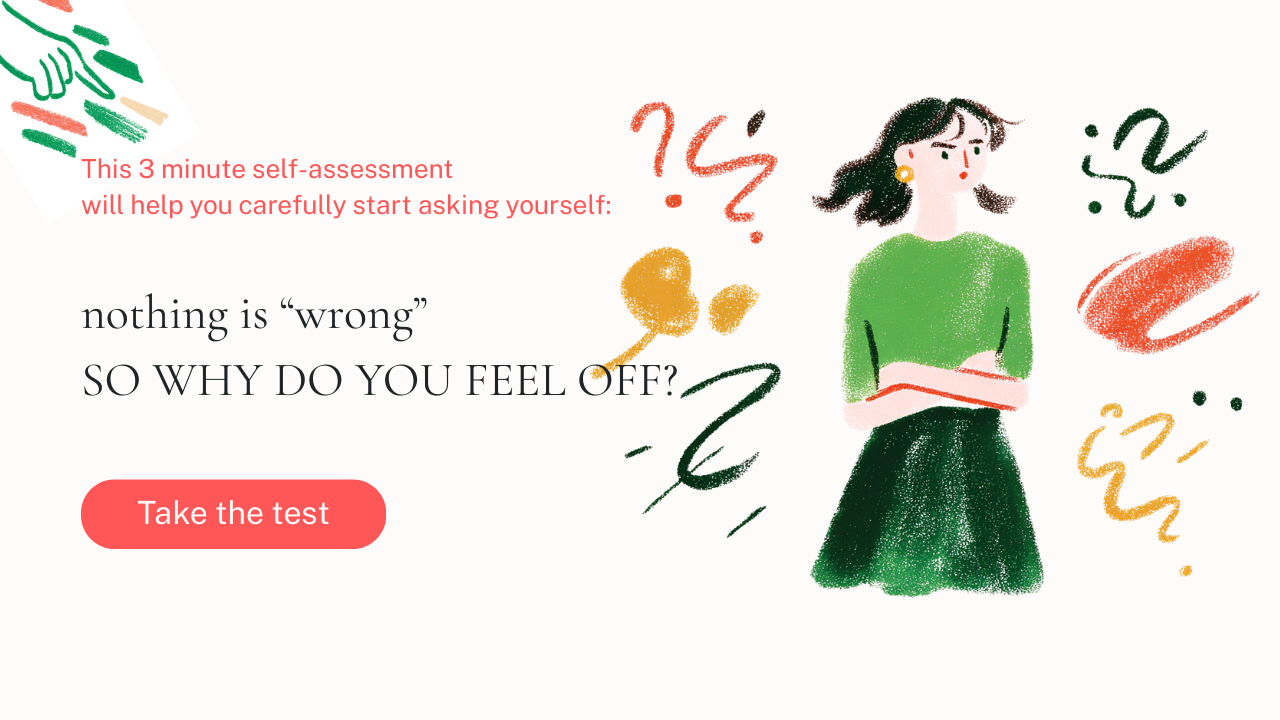
How to Get Clarity When You Can't Stop Overthinking
I’ve spoken with many women lately who describe the same thing in different words:
a sense of being stuck, off, or quietly misaligned in their work.
They tell me they want clarity. They are desperate for new direction.
They want something to shift, either inside themselves or in their career.
But here’s what always happens in these conversations:
The moment they begin speaking, the real story starts to reveal itself.
Not because they’ve already figured it out, but because speaking forces their thoughts to move from a foggy internal loop into something visible.
Something audible.
And that is the power of conversation:
it is both the tool and the data source.
Before we can understand ourselves, we have to hear ourselves.
Why conversation is the first tool for clarity
Many of the women I’ve spoken with recently have been overwhelmed by their own thoughts.
They’ve felt something was off in their work life—
a longing, a dissatisfaction, a desire for change—
but they hadn’t yet said it out loud in a way that revealed what was actually going on.
The moment we begin talking, something shifts.
Their language starts to sort their inner chaos.
Not because they suddenly “figure it out,” but because conversation gently forces coherence.
It’s the difference between thinking and hearing.
When you speak, you externalize your internal state.
You make the intangible visible.
And that’s when clarity begins.
The pattern I hear again and again: overwhelm
Across these conversations, there is one recurring signal that someone is in a transition:
Overwhelm disguised as action items.
They list everything they should be doing:
“I should develop this skill.”
“I should know what direction to take.”
“I should be more certain by now.”
“I should learn this new tool… and also that one.”
This flood of “shoulds” isn’t a plan.
It’s a symptom.
It’s what happens when you don’t yet know what matters most.
And you can’t know what matters most without inner clarity.
You cannot prioritize without identity.
So instead, the mind generates endless possibilities—
a kind of mental survival strategy in the absence of direction.
What conversation reveals that thinking alone can’t
When we talk, something essential happens:
All the thoughts that have been spinning internally finally land on the table.
Sometimes messy.
Sometimes contradictory.
Sometimes emotionally heavy.
It can feel like a kind of verbal overflow. What I lovingly call “mouth overwhelm.”
But this stage matters.
Because once everything is out, you can finally see it.
You can see the chaos for what it is:
a signal, not a solution.
Only then can the real story begin to emerge.
What I listen for when someone is in this clarity-seeking stage
These conversational cues are almost universal among women (and leaders) in transition:
1. Contradictions
They say one thing but feel another.
They talk about wanting stability and freedom in the same breath.
This isn’t confusion—it’s data.
2. Heavy words that no longer feel authentic
Sentences filled with pressure, obligation, and emotional weight.
This tells me they’re speaking from overwhelm, not identity.
3. Repeated phrases
Things that pop up that reveal an inner, deep longing that returns.
A specific complaint that resurfaces.
Or a sentence they didn’t know they believed until they heard themselves say it.
4. Emotional tone that doesn’t match the story
A sigh between sentences.
A drop in energy.
A sudden softness when something true slips out.
5. The longing underneath the language
They want clarity, yes.
But often they also want joy, meaning, creativity, simplicity, or a return to themselves.
These patterns don’t tell me what the answer is.
They tell me where to listen.
A story from a team in transition
I once worked with a team inside a large organization going through a digital transformation.
They were overwhelmed, frustrated, and resistant to change.
In our conversations, they talked endlessly about everything they felt should be different—
the tools, the structure, the processes, their department, their workload.
But none of them could speak about where the organization was actually heading.
They had no clarity.
No shared story.
No sense of direction.
And when people lack clarity, they cling to what feels familiar, even if it no longer works.
Had they been given a coherent narrative about where they were moving, most of their overwhelm would have dissolved.
Because knowing the next steps you are collectively taking, clarity, whether individual or collective, reduces chaos.
This is the same pattern I see in women in career transition.
If you feel overwhelmed right now, read this carefully
You may feel like you’re supposed to:
get your life together
learn five new skills
find your next career step
master AI
plan your future
become a better version of yourself immediately
But overwhelm is not a sign that you need to work harder.
It’s a sign that you need to empty the noise.
The clarity you’re searching for isn’t far away—
you just can’t hear it yet.
Because clarity doesn’t appear in chaos.
It appears after chaos has been spoken.
Why the first step is not figuring it out — but speaking it out
When you’re in the early stage of transition—the Root stage—your words may feel dramatic, emotional, confusing, or unclear.
This is normal.
This is the phase where:
your language is shaped more by emotion than strategy
your inner world feels noisy
you feel the gap between who you’ve been and who you’re becoming
you can’t yet articulate what you truly want
everything feels equally urgent and equally impossible
This is not the moment to make decisions.
Or to build a plan.
Or to judge yourself for not being “clear enough.”
This is the moment to speak.
To let the words come out as they are.
To let someone help you sort the noise from the truth.
Because beneath every chaotic conversation, there is always a quieter sentence waiting.
A sentence that shifts the entire direction.
And when you finally hear that sentence,
clarity returns.
You need to be heard
If you feel stuck, misaligned, or overwhelmed in your work, you don’t need to push harder.
You need to be heard.
Conversation is not just support.
It’s a diagnostic tool.
It reveals your current leadership story long before you can articulate it yourself.
Your next step may not be as far away as it feels,
you just haven’t spoken your way to it yet.
You don’t need to go it alone…
If you feel overwhelmed or unable to hear your own clarity right now, you’re not alone.
This is simply the beginning of a new story.
If you’d like a quiet space to speak it out, and begin hearing what’s true—I’d love to meet you at this place and maybe even in conversation.
Learn more about how to work through this strange existential spot, you’re in here.