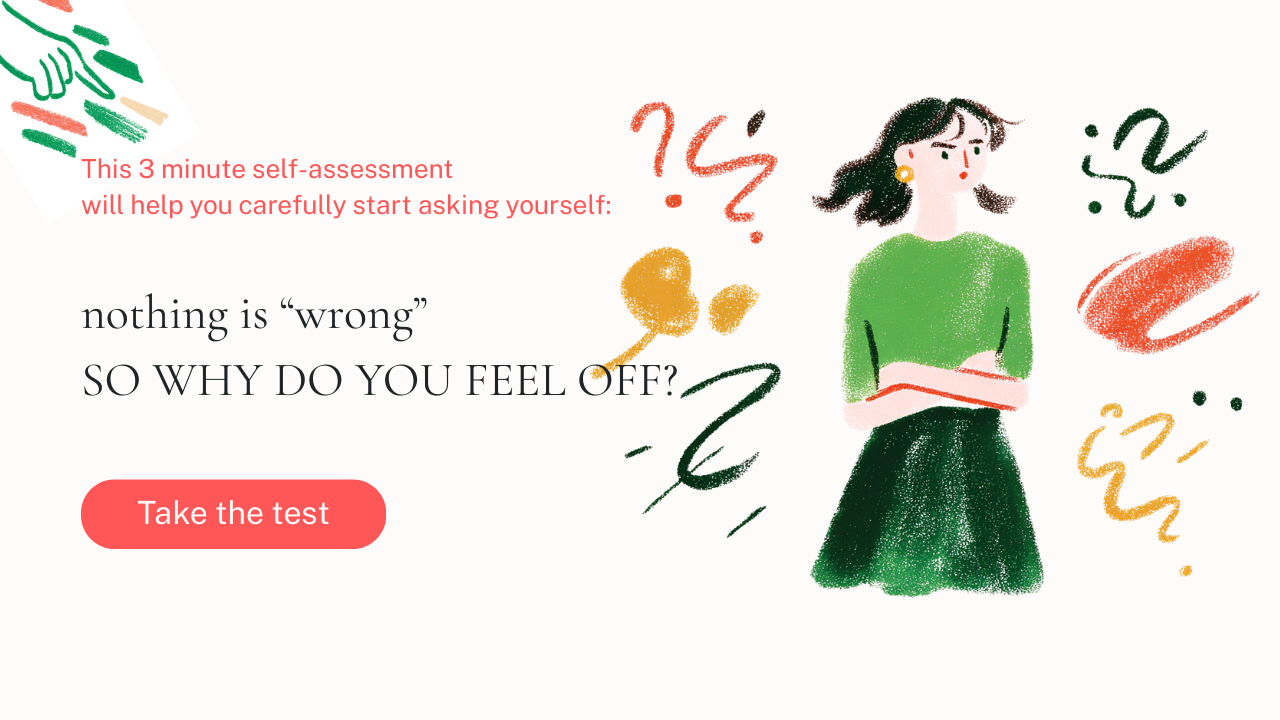
The Feeling That Something Is Off — Even When Everything Looks Fine
Nothing is terribly wrong.
You know that. Your life looks good — maybe really good. The job is there. The people you love are there. You've worked hard to build something stable, and it shows.
And yet.
There is something underneath all of it that doesn't quite settle. Not a crisis. Not a breakdown. Just a persistent hum that sits in the background of your days — sometimes quieter, sometimes harder to push down — but always there.
You've gotten good at managing it. You tell yourself things are fine. You remind yourself how much you have. On a normal Tuesday, or at the dinner table with people you love, or at the end of a workday, it surfaces — and you find a way to keep going. Because what else would you do? Nothing is obviously wrong. There's no clear problem to point to. No one is asking how you're really doing. And even if they were, you're not sure you could explain it.
But it won't leave you alone.
That feeling — the one you keep pushing down, the one that keeps coming back — is what this post is about. Why it's there. Why it persists. And why it's worth finally paying attention to, even when everything looks fine.
First — what this feeling is not
Before anything else, let's be clear about what this isn't.
It's not burnout. Burnout has a source you can point to — sustained depletion from something specific. This is different. You might not even feel depleted. You might feel fine, functional, even successful. Just quietly, persistently off.
It's not ingratitude. You know what you have. You're not taking it for granted. Feeling unfulfilled despite success doesn't cancel out everything that's right. Both things can be true at the same time.
It's not a sign that something has gone wrong. It might actually be a sign that something is ready.
And it's not something that will go away on its own. If you've been waiting for it to pass — and you've been waiting for a while — you already know this.
What the feeling actually is
Here is the most honest way I know to describe it.
The feeling is a signal. Your own life trying to get your attention. Not dramatically — it's not a siren. More like a hand on your shoulder that keeps returning, no matter how many times you gently move it away.
It persists because it's carrying real information. Information about what matters to you. About the gap between the life you're living and the life that would actually feel true. About something you know — have probably known for a while — that you haven't yet let yourself fully look at.
Women who feel lost even though their life is good often describe it exactly this way. Not a crisis. Not something they can easily name. Just a sense that something is off, underneath a life that looks completely fine from the outside.
One woman I spoke to in my research put it simply: "I know something is calling me. I just can't see it yet."
She wasn't confused or falling apart. She was doing something very precise — acknowledging the signal before she knew what it meant. Most women skip that step entirely. They go straight to managing it. Or they demand it produce a clear answer before they'll take it seriously.
But the signal doesn't work that way. It will just keep returning until you're willing to look.
Why it's so hard to name
Part of what makes this feeling so difficult is that it doesn't come with an obvious explanation.
If something were clearly wrong — a bad relationship, a job you couldn't stand, a situation you needed to leave — the path forward would be more visible. You'd have something concrete to work with.
But this isn't that. This is subtler. And subtler things are harder to justify taking seriously.
I think about a woman I've spoken to who has built a genuinely beautiful life. A home she loves. Children she is devoted to. A career going well by every measure. And yet, every time we speak, the same thing surfaces. The long commute. Leaving before her kids wake up. Arriving home after they've already needed her. A quiet grief about how far she is, every day, from the life she most wants to be living.
From the outside, the signal is unmistakable. Family is her core value. Presence matters to her deeply. And her daily reality is in direct conflict with both — every single day.
But she has already decided the problem is unsolvable. Too big. Too tangled. So she doesn't let herself look at it fully. She manages the feeling and keeps going.
What strikes me is that the knot she's describing has never really been examined. It's been decided against before the examination even started. And so the signal stays. Doing its job. Waiting.
This is one of the most common patterns I see in women who feel stuck in life but can't quite name why. Not that the problem is unsolvable. But that it has been pre-decided as too big to look at — and so it never gets looked at. It just keeps producing the signal instead.

When the feeling is about finally seeing clearly
Sometimes this feeling isn't about a specific thing you want to change. It's about arriving at a clarity you've been half-reaching for years.
Another woman I spoke to works inside a large organisation. She delivers. She shows up. She does everything right. But over time, something has shifted. She can see now — with a precision that only comes from years of paying close attention — who gets rewarded in her system. Whose instincts are trusted. Whose way of working fits.
And she has quietly understood that she is not it.
This isn't bitterness. It's clarity. The kind that arrives slowly, then all at once. And clarity, once it's there, is very hard to push back down.
The feeling she carries isn't quite longing. It's recognition. A signal that has been building evidence for years and has finally become too clear to ignore. She doesn't know yet what to do with it. But she knows. And knowing changes something — even before anything else does.
Women who feel this way often describe it as a corporate job that feels meaningless, or a growing sense that the life they've built on paper doesn't match who they actually are. The signal is the same underneath all of it.
When you can't see your own signal clearly
There's one more version of this worth naming — because it's more common than it might seem.
Sometimes the feeling isn't about what's wrong with the situation. It's about not being able to see yourself clearly enough to understand what the situation is asking of you.
I spoke with a woman who brings something remarkable into every room she enters. A warmth, a quality that makes people feel more capable just by being near her. You can see it from the outside immediately.
She cannot see it herself.
And because she can't, she can't locate where she actually belongs. She can't choose environments that deserve her. She can't draw the boundaries that would protect her. She can't ask for what she's worth.
The result is a low, ongoing friction. A persistent sense that something is off — without being able to name exactly what. The signal keeps returning because the gap between who she actually is and how she allows herself to be seen never closes.
This too is a signal. A quieter, more confusing one. But the same hand on the shoulder. The same patient waiting.
What it costs to keep pushing it down
The feeling is easier to work with now than where it ends up if it goes unanswered long enough.
That's not a warning. It's just what I've seen.
The women who have been managing this signal for years describe something specific — not a dramatic unraveling, but a slow dimming. A flatness that wasn't there before. A growing impatience with things that used to feel fine. The sense of going through the motions. Functioning well, but not really present. Not really there.
The woman grieving the distance from her children didn't get there overnight. The woman who finally saw her system clearly didn't arrive at that recognition in a single moment. The woman who can't see her own value has been accumulating that friction for years.
The signal didn't ask for much at the beginning. Just to be heard.
Feeling stuck in life — even when nothing is obviously wrong — has a way of compounding quietly. The longer it goes unexamined, the heavier it gets. Not because you've failed at anything. But because you've been very good at managing something that was never meant to be managed. It was meant to be listened to.
What listening actually looks like
It doesn't start with a decision. Or a plan. Or knowing what you want.
It starts with something much simpler: being willing to stop managing the feeling long enough to ask — honestly, without demanding an immediate answer — what is this actually saying?
Not solving it. Not explaining it away. Just looking at it directly, maybe for the first time.
That's harder than it sounds, for women who are very good at managing things. But it's also less dramatic than it might feel. You don't have to blow up anything. You don't have to change everything. You just have to stop overriding the signal long enough to hear it.
The Inner Authority Method was built for exactly this starting point. The first phase — Root — isn't about deciding anything or figuring out what comes next. It's about learning to hear your own signals clearly. What gives you life. What drains it. What keeps trying to get your attention, even when you'd rather it didn't.
You don't need to know what the feeling is pointing toward before you begin. You just need to be willing to look at it honestly.
That is enough to start.