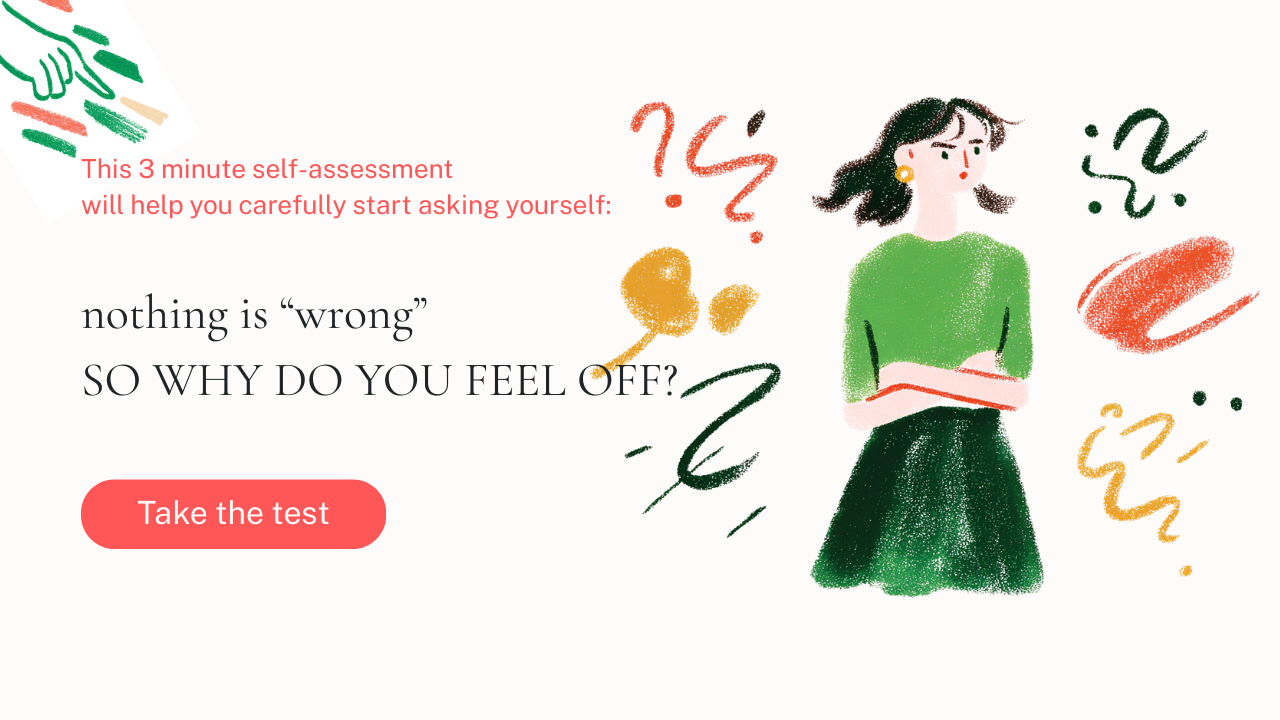
Why High-Achieving Women Are the Last to Listen to Themselves
When I have been working on my research for my framework to navigate life change, The Inner Autority Method, I have met my fair share of women, who are very good at everything except hearing themselves. Or rather, listening to themselves.
This woman is often competent. Reliable. The person others come to when something needs to get done. She has built things — a career, a reputation, a stable life — through a combination of intelligence, hard work, and an almost automatic ability to figure out what a situation requires and deliver it.
She is, by most measures, doing well.
And she is the last person in the room to notice that something inside her has been quietly asking for attention for a very long time.
This is not a coincidence. The same qualities that make her exceptional at navigating the world make her exceptionally good at overriding herself.
The skill that works against you
High-achieving women are, almost by definition, skilled managers of difficulty.
When something is uncomfortable, they address it. When something is unclear, they think it through. When something feels wrong, they find a way to make it work — or to make peace with it, or to reframe it, or to get busy enough that it stops being the loudest thing in the room.
This is a real skill. It has produced real results. It has gotten her through hard things.
But there is a cost to being very good at managing yourself, and it's this: you can manage yourself right past the information your own life is trying to give you.
The discomfort that was supposed to be a signal gets handled. The longing that was supposed to point somewhere gets reframed into something more responsible. The quiet question that kept coming up at inconvenient moments gets noted, and filed, and returned to later — except later never quite comes.
She is so good at dealing with things that she deals with herself too.
The competence trap
Here's something that doesn't get said often enough: competence is one of the things that makes it hardest to change.
When you're not capable, the gap between where you are and where you want to be is obvious and urgent. You have to move. The situation demands it.
When you are capable, you can stay. You can make the current situation work. You can perform the role well enough that nobody — including you — has to look too closely at whether the role is true.
One woman I spoke to described it like this: "I've spent so much of my life performing roles people needed from me." She was not describing someone who had failed at anything. She was describing someone who had succeeded so thoroughly at being what others needed that she had lost track of what she actually was.
Another said: "It looks good on paper. But it never felt right."
Both of those sentences contain the same thing: a woman who was good enough at the external version of her life that the internal version could be quietly set aside. For years.
Why she doesn't trust the feeling
When the signal finally gets loud enough to pay attention to, the first instinct is usually not to listen to it. It's to question it.
Is this real, or am I just tired?
Is this genuine dissatisfaction, or am I being ungrateful?
Would I feel this way if I just took a holiday / changed jobs / sorted out my sleep?
Do I actually want something different, or do I just want to complain?
These are not irrational questions. They are the questions of an intelligent woman applying her analytical mind to her own inner life. The problem is that the analytical mind is not always the right tool for this particular job.
The mind is very good at evaluating options, solving problems, and building plans. It is less good at listening. At sitting with something uncertain and letting it be uncertain. At trusting a signal that cannot yet be translated into a clear next step.
High-achieving women tend to be exceptional at the former. They are often much less practiced at the latter.
And so the feeling gets interrogated rather than heard. It gets managed rather than followed. It gets set aside — again — until the next time it surfaces.
The permission problem
There is something else underneath all of this that is worth naming directly.
Many high-achieving women have spent decades being the one who holds things together. The responsible one. The one who thinks about the consequences before she acts. The one who makes sure everyone else is okay before she considers what she needs.
Asking what is true for her — not what is needed, not what is expected, not what would be responsible — can feel almost transgressive.
Not because she is weak. Because she has been so thoroughly trained to orient outward. To read the room. To understand what the situation requires and provide it.
Turning that same attention inward, and letting what she finds there actually matter, requires a different kind of permission than she has been used to giving herself.
One woman in exactly this moment said it as plainly as it can be said: "I don't dare to dream."
Not because her dreams had gone. Because somewhere along the way, dreaming had come to feel unsafe. Impractical. Something to be managed, like everything else.
What listening to yourself actually requires
It does not require blowing anything up.
It does not require quitting your job or ending your marriage or making any dramatic move before you are ready. It does not require certainty. It does not require knowing what you want before you start looking.
What it requires — first, before anything else — is deciding that what is true for you is worth paying attention to.
That sounds simple. For high-achieving women, it is often the hardest thing.
Because the moment you start really listening, you have to take seriously what you hear. And taking it seriously means you might have to do something about it. Or at least sit with the honest knowledge of it. And you cannot unknow what you genuinely know.
That is frightening, in a subtle way.
But the alternative — continuing to be very good at managing yourself past what is actually true — has a cost too. It just spreads the cost out over time, in ways that are easier to ignore.
What a structured process gives you that willpower alone doesn't
This is where most approaches fail her.
She tries journaling. She goes in circles — the same thoughts in a different order. She reads the books. Good ideas, but nothing that makes her feel genuinely seen, or gives her a clear sequence to follow. She waits for clarity to arrive on its own. It doesn't.
The problem is not that she isn't trying hard enough. The problem is that open-ended reflection without structure tends to produce more noise, not less. When you are already inside the confusion, asking yourself open questions sends you deeper into it.
What actually helps is a sequence. A clear path through the confusion that holds you while you do the work of looking — so you don't have to invent the process at the same time as you're trying to navigate it.
The Inner Authority Method works in four phases, and the first one — Root — is specifically designed for this moment. Not to push her toward a decision. Not to ask her to know what she wants before she's ready. But to help her develop what I call internal signal literacy: the ability to hear what her own system is actually telling her, separate from the noise of what she should want, what would be responsible, what others need from her.
It starts with mapping her energy — what gives life, what drains it, what she keeps being pulled toward even when she tries to ignore it. Then her values — not the ones that sound right, but the ones that are actually operating in her. Then the deeper drive that has moved her through her life, even when she couldn't name it.
By the end of Root, she hasn't made any decisions. She hasn't changed anything. But she has something she didn't have before: a clearer relationship with her own signals. A reference point that is hers, not borrowed from what everyone else needs her to be.
That is what makes everything after it possible.
The thing that changes when she finally listens
Here is what I have seen, in the women who do stop and listen.
They don't fall apart. They don't blow anything up. They don't regret hearing what they hear.
What happens is something quieter. A kind of relief. The relief of stopping the management. Of letting the signal be what it is. Of giving yourself permission to know what you know.
One woman described it like this: "If I had clarity, I know I would make it happen."
She already had everything she needed except the clarity. And the clarity was always available — it had just been managed out of reach.
The work is not to find something new inside yourself. The work is to stop being so efficiently competent at pushing aside what has always been there.
If you're ready to stop overriding the signal — the Inner Authority Method is a structured way to start listening.