The Strengths That Make You Special Are the Ones You Can't See
For a long time, I built a career without fully understanding what I was actually bringing to it. I worked hard. I delivered. I took on more responsibility when it was offered. I got things done — and I got things done in a particular way, through relationships, through creating alignment across different parts of an organisation, through finding the common thread between people who didn't think they had one.
I was good at it. I knew that, in a vague way. People told me. The results were visible. But I never truly claimed it.
Because it came so easily. Because it felt less like a skill and more like just — the way I am. The way I naturally move through a room, through a problem, through a team. It never occurred to me that not everyone could do it. It never occurred to me that it was something worth naming, worth protecting, worth asking to be rewarded for. So I didn't ask. Not for a long time.
And looking back, I left a lot on the table — not because I lacked the ability, but because I lacked the ownership of it.
That is the thing about your real strengths. The ones that are most distinctly yours are the ones that feel most ordinary to you. And because they feel ordinary — you don't see them. You look right past them. You wait for something that feels more earned, more effortful, more obviously impressive.
And in the waiting, you underestimate yourself in ways that have real consequences.
What we think strengths look like
We have been taught to think of strengths as things we worked for.
Skills we trained ourselves to have. Competencies we can list on a CV. Things we can point to and say — I learned this, I built this, this is what I can do.
And those things matter. They are real. There is genuine pride in having developed capabilities through effort and experience.
But there is a different category of strength that sits underneath all of that. One that does not appear on any CV. One that no training produced. One that has simply always been there — so present, so natural, so much a part of how you move through the world that you have never once thought to name it as something special.
It is not what you trained yourself to do. It is what you cannot help but do. And that is exactly why you cannot see it.
The promotion I didn't see coming
Early in my career, I found myself in a role that didn't quite fit. I had landed there somewhat accidentally — the way many of us end up in roles we didn't exactly choose — and I was doing the work, but I didn't feel called by it. I felt like I was searching for something. Still figuring out where I actually belonged.
And then one day, my manager called me in and offered me a promotion.
I remember being genuinely confused.
I hadn't worked toward it. I hadn't brought myself forward for it. I hadn't thought of myself as someone who was ready for it. The role itself wasn't even something I was sure I wanted.
But she saw something. Looking back, I think she saw things I was carrying without knowing I was carrying them. The fact that I had built a life in a country that wasn't mine. That I showed up every day in a language and a culture that required a constant, invisible effort that I had long since stopped noticing. That there was something in the way I moved through difficulty — not loudly, not with a lot of drama, just steadily — that read as capability to someone watching from the outside.
She could see it. I couldn't.
And that is the strange thing about the strengths that are most fundamentally yours. They become part of the background of your own life. You stop registering them as anything notable. You assume that because they require no effort from you, they must not require particular effort from anyone.
They do. You have just forgotten that.
The work you took for granted
Later, in a different role, I was doing something I was genuinely exceptional at — and I barely noticed.
I was building relationships across a large organisation. Creating alignment between people and teams who didn't naturally work together. Taking something complex and fragmented and finding the thread that connected it — and then holding that thread while everyone else found their way to it.
It worked. Significantly. The results were visible and people said so.
But because it came naturally — because it was simply how I approached the work, not something I had to strategise or force — I didn't claim it. I didn't say: this is what I do, this is what makes this possible, this is what you would lose if I weren't here.
I waited until the evidence was so overwhelming that I couldn't ignore it anymore. Until enough people had said enough things that I finally began to think — maybe I can actually do something here that not everyone can do.
It took much longer than it needed to.
And I think about what would have been different if I had been able to name it earlier. If I had been able to say, clearly and without apology: I am exceptionally good at building the kind of trust that makes large, complex change possible. That is not a small thing. That is worth something.
I couldn't say it then. Not because it wasn't true. Because it felt too much like just — me.
What changes when you finally say it out loud
Recently, I was taking on a freelance project — building something new while also building Eksakt — and I found myself in a conversation about what I bring.
And I said it. Clearly. Without hedging.
I am a skilled relationship builder. It is one of the things I am genuinely exceptional at. It is invisible as a skill because it looks like warmth, like interest, like just being good with people — but it is a specific capability that produces specific results, and it will matter for this project.
I noticed something as I said it.
It felt natural. Not boastful. Not performed. Just honest.
And I realised: this is what it feels like to have finally taken ownership of something that was always true. Not to have built a new strength. To have claimed one that was already there.
That is the shift. And it changes something — not just in how others see you, but in how you move. In what you ask for. In what you bring forward. In the rooms you walk into and what you offer when you get there.
Why you can't see your own strengths
Here is the mechanism, as clearly as I can state it.
The things that are most deeply yours feel effortless to you. And we have been conditioned to believe that effortless things are not impressive. That real strength looks like struggle. That if something comes easily, it cannot be that valuable.
So you discount it. You look past it. You wait for the thing that feels more earned.
Meanwhile, the people around you are noticing exactly the thing you have decided doesn't count. They come to you for it. They rely on it. They would miss it immediately if you weren't there — even if they couldn't tell you precisely what they would miss.
The gap between how clearly others can see your real strengths and how little you can see them yourself is one of the stranger features of being human. And it has real costs — in the opportunities not claimed, the value not articulated, the rooms not walked into with the full weight of what you actually carry.
How to start seeing it
You cannot see your own strengths by thinking harder about yourself. That produces the same list it always has — the CV version, the trained version, the things you worked for.
What works is looking sideways.
Think about someone you admire. Not their credentials — what they actually do. The way they hold complexity without making it complicated. The way they sense a room. The way they make difficult things feel possible.
You can see it in them with complete clarity.
You already have that filter. You have just never turned it on yourself.
So turn it.
What do people consistently come to you for — not because you asked, but because they instinctively know to bring it to you?
What do you do where people say afterwards, "thank you, that really helped" — even when you can't quite point to what you did?
What would people miss if you weren't there — without being able to name what they would miss?
What do you do easily that you have watched others struggle with — and quietly assumed must just not be a priority for them?
The answers to those questions are not small things. They are the most important things. They are what makes you necessary rather than replaceable.
They are just invisible to you. Because they are too close. Because they are simply the way you are.
The ownership question
Seeing the strength is one thing. Claiming it is another.
Claiming it means saying it out loud — to yourself first, and then to others. Not as a performance. As an honest statement of fact.
It means asking for what that strength is worth. It means walking into rooms with the full weight of what you carry, instead of waiting for someone else to notice and name it for you.
Your manager might notice. A client might name it. Someone watching you from the outside might call you in and offer you something you didn't think you had earned.
But you cannot build a career — or a life — on waiting to be seen.
At some point, you have to do what I eventually did. Say it clearly. Without hedging. Without waiting for the evidence to become so overwhelming that you can no longer ignore it.
This is what I bring. It is real. It is valuable. And it will matter here.
But here is what I have also learned
The question of what you are good at is rarely the real question.
It is the question you arrive at when something larger is out of balance. When a subtle, persistent feeling has been building — that something is off, that the life or the work or the direction doesn't truly fit — and you start examining the pieces, one by one, looking for where the misalignment lives.
Your strengths. Your purpose. Your direction. What you are supposed to be doing with all of it.
These are good questions. Important ones. But examining the pieces in isolation — without understanding what is actually out of balance at a deeper level — is exhausting. And it rarely produces the clarity you are looking for.
Because the real question is not what are you good at.
It is: what is actually true for you right now — underneath the career, underneath the performing, underneath the version of yourself you have been presenting to the world?
That is the question that, when answered honestly, makes everything else — including your strengths — start to make sense.
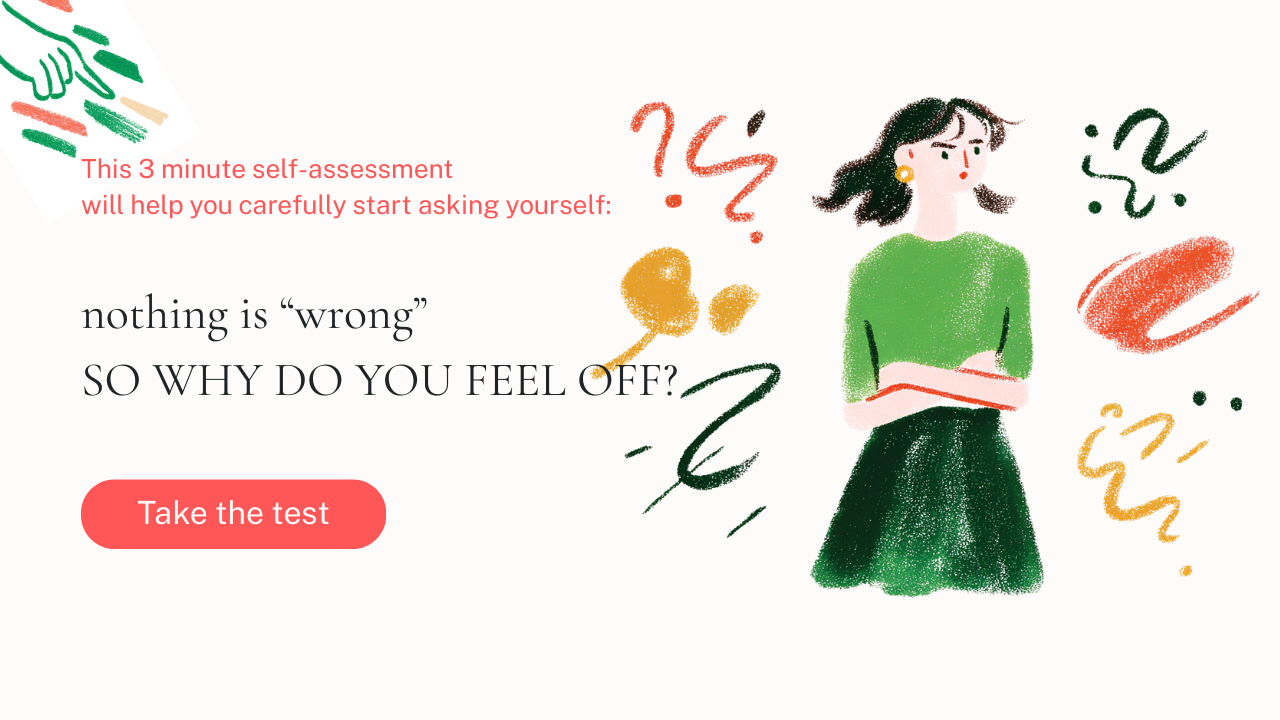
If you are somewhere in that territory — sensing that something is off, not quite able to name what — there is a short assessment called the Nothing Is Wrong assessment linked below.
It takes two minutes. It does not ask you what your strengths are, or what you want, or what you should do next.
It helps you see, at a higher level, what is actually out of balance for you right now.
Because that is the real question underneath all the others.
And it is always the right place to begin.