Why You Feel Lost Even Though Nothing Is Wrong
You are not in crisis.
Nothing has collapsed. Nobody is sick. The job is still there. The people you love are still there. From the outside, your life looks like the result of a lot of good decisions.
And yet — underneath all of that — something is asking a question you cannot quite answer. Not loudly. It doesn't announce itself. It's more like a hum. A low, persistent signal that keeps breaking through when things get quiet. In the car. Last thing at night. On a walk you've taken a hundred times.
You can't fully name it. And because you can't name it, you're not sure you're allowed to take it seriously.
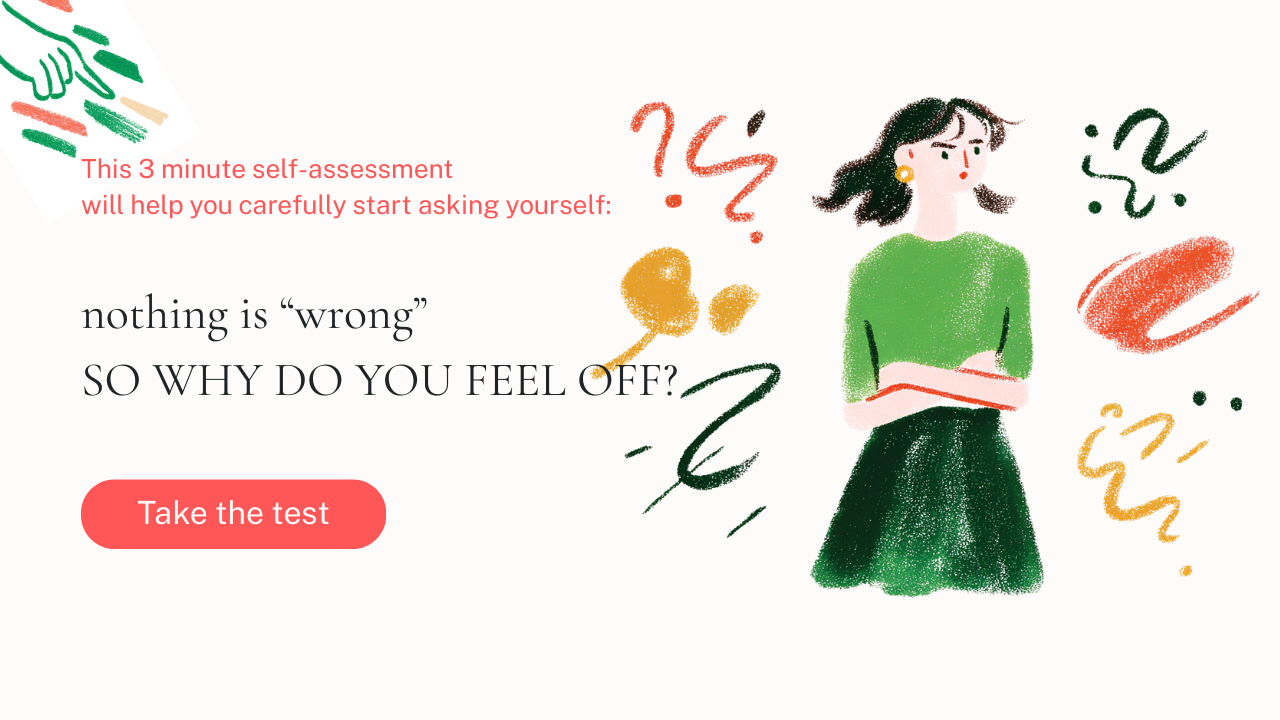
This post is about that feeling. What it is, what it isn't, and why it actually makes complete sense that you're feeling it right now.
First: what this is not
It's not burnout. Burnout has a clearer shape — it comes from sustained depletion, and it usually has a source you can point to. If you were burned out, you'd know. You'd feel the exhaustion all the way down.
It's not a breakdown. Nothing is falling apart. You're still functioning well — probably extremely well. The people around you would be surprised to know this is happening at all.
It's not ingratitude. You know how hard you've worked to build what you have. You know other people have it harder. You are not unaware of your own luck. And still — the feeling persists.
What it actually is: something more specific, and strangely, more hopeful than any of the above.
The life that works on paper
There is a particular kind of lostness that belongs to capable people.
Not the lostness of someone who has no footing — no job, no stability, no sense of direction. That is a different and real kind of pain. This is the other kind. The lostness of someone who did everything right, built something solid, and then arrived somewhere that looks correct — but doesn't feel it.
A woman in exactly this moment once described it to me as: "It looks good on paper. But it never felt right."
Another said: "I've spent so much of my life performing roles people needed from me."
And another, quietly: "I know something is calling me. I just can't see it yet."
These are not women who have failed. These are women who have succeeded — by every external measure — and discovered that external success doesn't automatically produce internal truth. The two things are related, but they are not the same thing.
Why intelligent women are the most likely to feel this
Here is something worth saying clearly: the more competent you are, the easier it is to override your own signals.
You are good at figuring things out. You are good at making things work. You are good at holding it together. These are real skills — and they have served you. But there's a shadow side to all of that capability. When you're very good at managing things, you can manage yourself right past the information your own life is trying to give you.
You notice the feeling. And then you deal with it. You reframe it. You get busy. You remind yourself to be grateful. You make a plan. You do the thing that you've always done when something uncomfortable comes up: you competently handle it.
Except this feeling doesn't resolve. It comes back. And every time it comes back, it's a little bit louder than before.
That's not a coincidence. That's information.
What the feeling is actually telling you
There's a way of thinking about this moment that changes everything.
What if the feeling of being lost — even when nothing is objectively wrong — is not a sign that something has broken? What if it's a sign that something is ready?
The women I've talked to who are in exactly this moment are not women who have gotten their lives wrong. They are women whose lives are asking something new of them. There's a difference. A big one.
The first framing means something needs fixing. The second means something needs listening to.
You don't need to blow anything up. You don't need to change everything, quit your job, or make a dramatic move. What you need — first, before anything else — is to stop overriding the signal, and to start getting curious about what it's actually saying.
The overthinking loop
One of the most common experiences in this moment is the loop.
You start thinking about what you want. You circle around it. You think about what a change might look like, what it might cost, what other people would think, whether you're being realistic, whether you're being selfish, whether the whole thing is just midlife restlessness that will pass if you just get enough sleep.
And then you come back to the same place you started.
The loop is exhausting. And it's also — I want to say this gently — completely normal. It is not a sign that you're confused or indecisive or emotionally unstable. It's a sign that you're trying to think your way to clarity without the right structure to think through.
Clarity doesn't usually come from more thinking. It comes from stepping back far enough to see clearly. From outside the noise, not inside it.
This is why structure helps more than you might expect. Not rules, not a prescription for what your life should look like. But a sequence. A clear path through the confusion that holds you while you do the work of actually looking.
What you don't have to do
You don't have to have it figured out to begin.
You don't have to know what you want before you start looking. You don't have to have a plan. You don't have to be ready to change anything. You just have to be willing to be honest — with yourself, quietly, in a room where it's safe to think.
The feeling you have — the hum, the low signal, the question that won't leave you alone — is not a problem. It is the most honest thing about you right now.
It's worth listening to.
If you're curious about what a structured way through this looks like, the Inner Authority Method was built for exactly this moment.